Real clients. Real systems. Real impact.
We evaluate three categories of AI systems. Each presents different risks, different failure modes, and different questions for the organization that deploys it.
-
Classifiers, scoring models, and decision-support tools have been making high-stakes decisions for years, including HR, criminal justice, insurance, credit, and public services. The risks are well-documented but still routinely under-measured: biased training data, threshold decisions that affect different populations differently, model drift that degrades accuracy over time, and human reviewers who approve system outputs without meaningful scrutiny.
In these systems, we evaluate:
data quality and representativeness · feature engineering and proxy variables · threshold logic and business rules · bias and fairness across protected groups · human-in-the-loop adequacy · performance stability over time in production.
-
Generative AI introduces risks that traditional testing frameworks were not designed for: outputs that are plausible but wrong, retrieval pipelines that surface stale or inappropriate content, and workflows where human review has been quietly removed because the system seems good enough. The gap between how a model performs on benchmarks and how it behaves in your specific deployment is where the real exposure lives.
In these systems, we evaluate:
hallucination rates and output accuracy · retrieval quality and source reliability · prompt injection and adversarial robustness · output consistency across user populations · privacy and data leakage · human oversight adequacy.
-
Autonomous agents and multi-step AI pipelines operate with a degree of independence that makes traditional testing insufficient. When a system can take actions, call tools, and chain decisions across multiple steps, the failure modes are harder to anticipate and the consequences harder to contain.
In these systems, we evaluate:
action traceability and audit trails · goal alignment across multi-step sequences · failure mode identification and recovery behavior · tool use boundaries and access controls · human escalation paths and override adequacy · downstream impact of autonomous decisions.
Browse by industry
Explore how Eticas evaluates and improves AI systems across sectors. Each industry highlights the key applications where we’ve provided audit, risk and governance support.
Don't see your sector? We've likely worked on it
Industry detail
Healthcare
In healthcare, the cost of an AI system that underperforms for a specific population is measured in human lives, and systems are often high-risk under regulation.
We evaluate diagnostics support tools, AI-enabled medical devices, and patient-facing applications... with a socio-technical lens that includes clinical workflow integration, data representativeness, and the human oversight structures that sit around the system in practice.
Healthcare case studies
Industry detail
Education
AI is entering classrooms faster than the evidence base for its effectiveness.
We evaluate career advisory platforms, learning support tools, and student assessment systems... assessing whether they perform consistently across different student populations, whether their recommendations are grounded in reliable data, and whether the institutions deploying them have adequate oversight in place.
Education case studies
Industry detail
HR & hiring
AI systems in HR make decisions that affect people’s livelihoods. They also carry some of the highest regulatory exposure under both the EU AI Act and existing employment law.
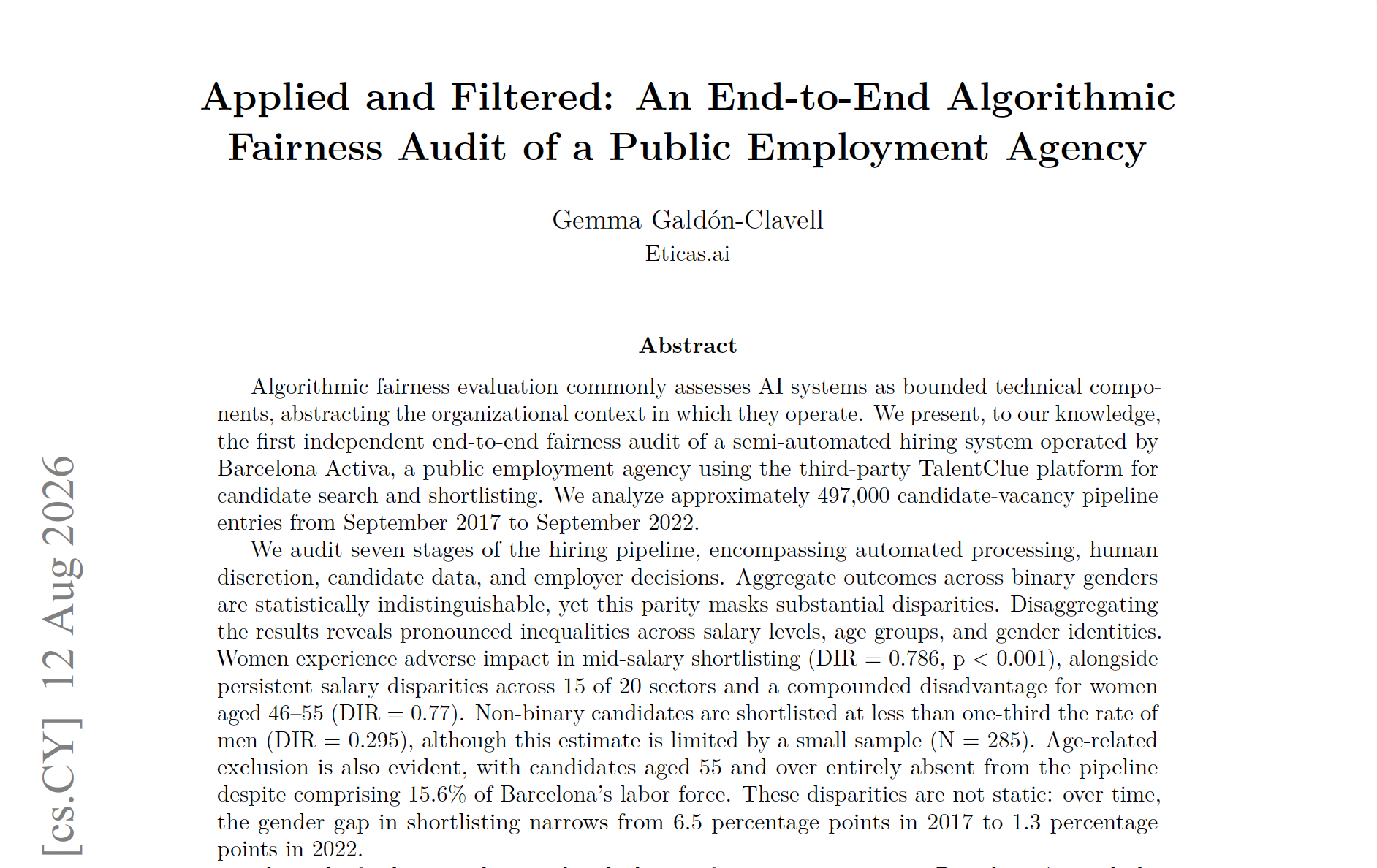
We evaluate screening and ranking systems, assessment scoring tools, and candidate matching algorithms... with a particular focus on bias, fairness across protected groups, and the adequacy of human involvement at the points where human judgement is critical.
Recruitment & HR case studies
Industry detail
Public Sector
When AI informs public decisions, from allocating social support to assessing risk, fairness, accuracy, and accountability are essential, especially as many systems become high-risk under emerging regulation.
Government teams use our audits to understand how models behave with real populations, where disparities may appear, and whether governance and data practices meet public-sector standards.
Our work focuses on subgroup performance, potential bias, documentation for oversight bodies, and the human workflows surrounding each system to ensure AI strengthens public services rather than reinforcing existing inequities.
Public Sector case studies